Chapter XXXII - Maritime Mail
Egypt: Stamps & Postal History
Introduction
This chapter is concerned with mail that was posted on board ships sailing to or from Egypt, or at ship-side shore facilities. In the pre-philatelic period, international mail was customarily entrusted to captains of ships for carriage to the port of address. Such letters are known from as early as the fourteenth century. However, they bore no handstamped markings, but only directions in manuscript (generally in Italian) with the name of the ship's captain. The first handstamped ship markings from Egypt were those of arrival at Toulon or Marseille during the Napoleonic occupation.
The Maritime Service of the Egyptian Posts
It is necessary to begin with some words about the Egyptian steamship line that operated in the eastern Mediterranean and in the Red Sea. It was founded as the Medjidieh Company on February 1st, 1857, flying the Turkish flag. Ismail Pasha, on becoming Viceroy, authorized the formation of the Egyptian Company for Steam Navigation on May 4th, 1863. It was granted a monopoly for passenger and freight traffic on the Nile and adopted the name Azizieh Misri Company. In 1870, the Government took over full control, renaming it the Administration des Paquebots Postes Khediviaux.
Eventually, the Company was sold to British interests in 1898 and operated as the Khedivial Mail and Graving Dock Company (KML).
Post offices were installed on the ships around 1875. The Postal Administration provided special date-stamps, inscribed UFFIZIO NATANTE ("floating office") (Fig. 1). In addition to the changeable date, a changeable slug reading either ALES. or COSP. was included to indicate the direction of sailing. The designation for this type is SP.O-1. Examples are very scarce but not rare on loose stamps, but covers are rarities.

Paquebot Mail
Letters posted on board ships arriving at Egyptian ports were commonly franked with stamps of the appropriate country (Turkish, Austrian, Greek, British, or French). If turned over to the Egyptian post office at the port of arrival, the custom was to cancel the stamps with the retta, which did not give a false indication of origin.
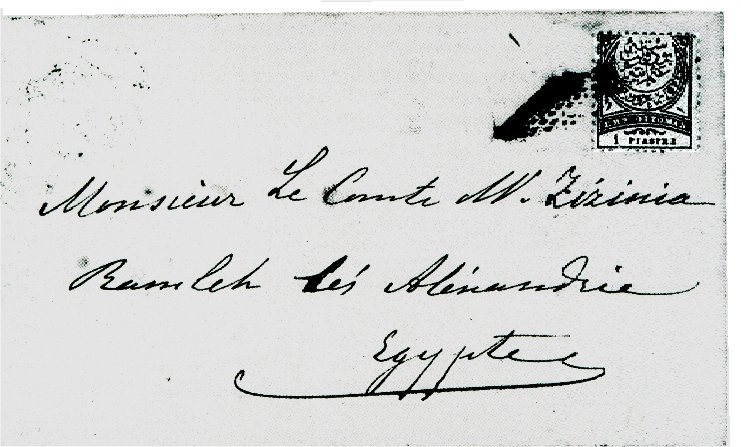
The UPU Congress in 1891 developed the paquebot convention. Egypt complied promptly and provided handstamps reading PLEINE MER to its major ports (Fig. 3). These handstamps were customarily struck on the cover near the stamps, which were cancelled with the normal date-stamp of the port.

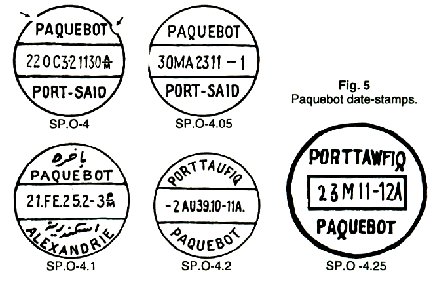
When the UPU settled on the use of the word "paquebot", Egypt issued new handstamps (Fig. 4), introduced around 1899. Port Taufiq was added to the group at this time. These paquebot handstamps were commonly used to cancel stamps, in contrast to the "pleine mer" types. The great majority are on covers franked with British stamps in the earlier years.

By 1914, Port Said was given a circular date-stamp (Fig. 5) incorporating the word "paquebot". Alexandria also received a circular paquebot date-stamp (reported 1925-68). Port Taufiq was at first given a small date-stamp with spelling TAUFIQ, replaced in 1956 by a larger device spelling TAWFIQ.
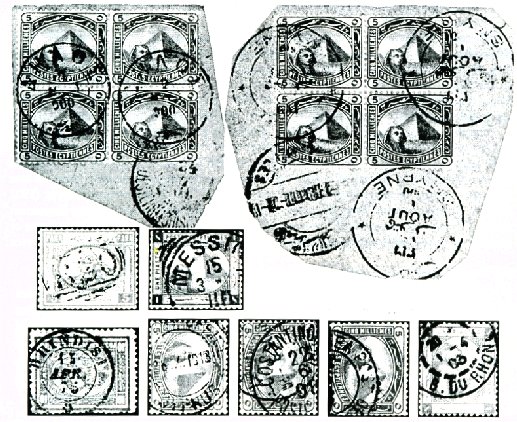
Mail from ships leaving Egypt also received paquebot treatment at ports of arrival in foreign countries. Egyptian stamps may be found cancelled with the paquebot handstamps of ports in England, France, Italy, Greece, Turkey, and others (Fig. 6).
Foreign Sea Post Offices
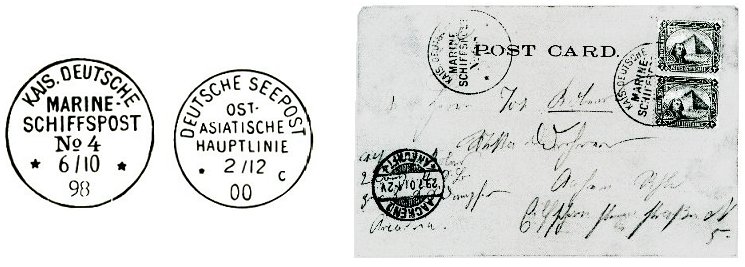
German: Germany operated steamships through the Suez Canal to serve Colonies in East Africa, the Far East, and the Pacific. Most ships carried sea post offices inscribed DEUTSCHE SEEPOST. German naval vessels also carried post offices (1895-1914), inscribed KAIS. DEUTSCHE MARINE-SCHIFFSPOST. Egyptian stamps were rarely used on such mail (Fig. 7).
Romanian: The Royal Romanian Steamship Line carried a post office on the Constanta-Alexandria route. Four types of cancellation are known, including CONSTANTA-ALEXANDRIA and later BIR. AMB. MARITIM (Fig. 8).

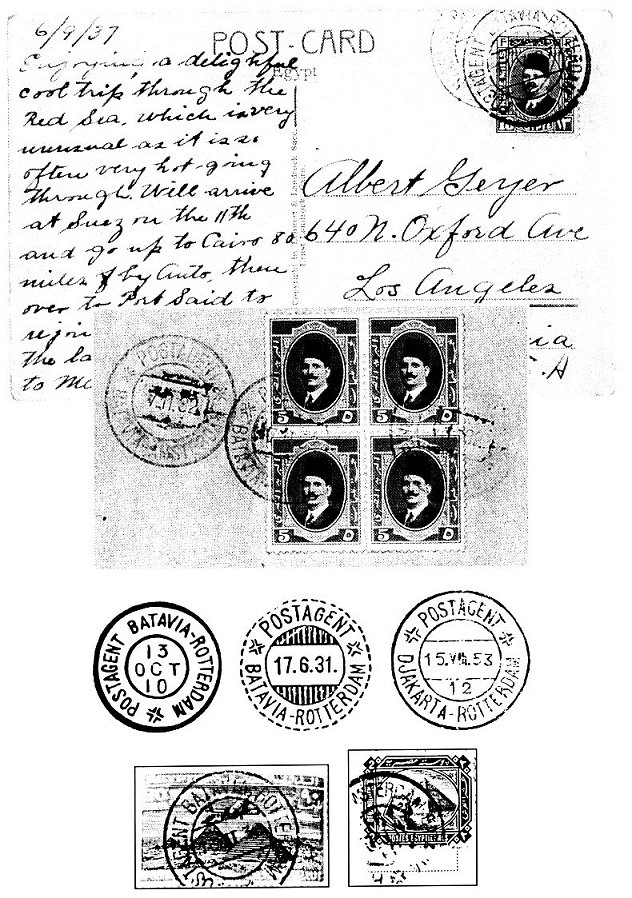
Dutch: Sea post offices were carried on board Dutch ships plying the route to the Dutch East Indies via the Suez Canal. Date-stamps read POST AGENT / AMSTERDAM-BATAVIA or similar variants (Fig. 9).
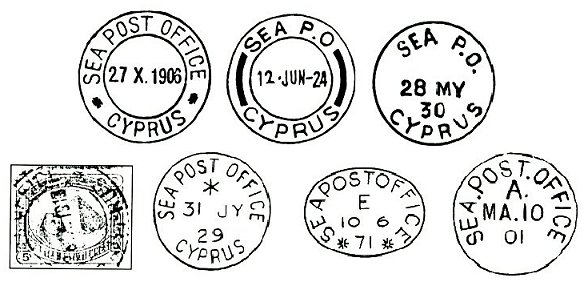
Cyprus: Cyprus maintained a sea post office on ships sailing between Cyprus and Egypt. Contracts were held by the Limassol Steamship Company and later the Khedivial Mail Line. Date-stamps are shown in Figure 10.
Indian: A sorting office of the Indian postal service was provided on P&O steamers carrying mails between Suez and Bombay. Date-stamps reading SEA POST OFFICE were used (Fig. 11).
Handstamps of Private Shipping Lines
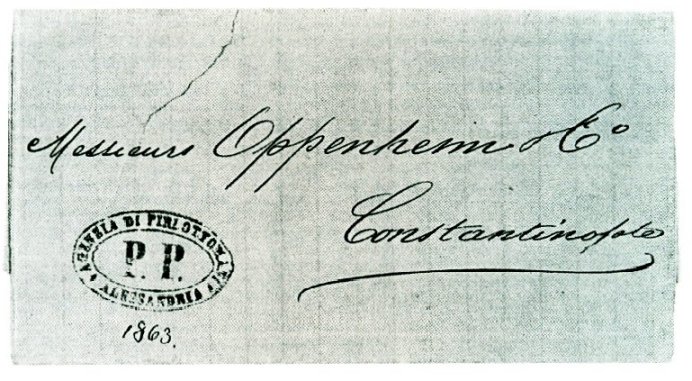
The earliest handstamp of a private shipping line is that of the PIROSCAFI OTTOMANI (Fig. 12), found on stampless covers from 1863.
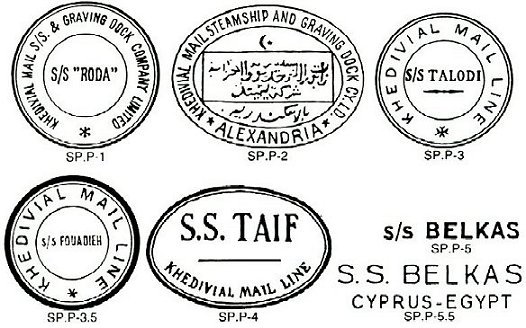
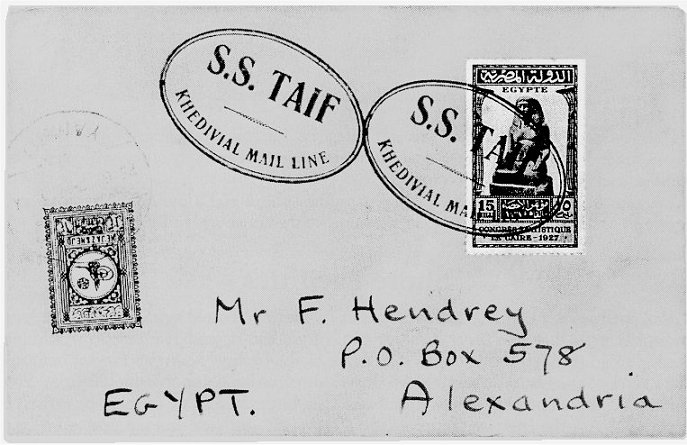
In the twentieth century, handstamps of the Khedivial Mail Line can be found cancelling Egyptian stamps (Fig. 13). Most covers on the market are "Hendrey" covers (Fig. 14), produced by Alexandria dealer F. Hendrey between 1928 and 1932.
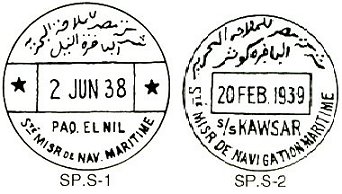
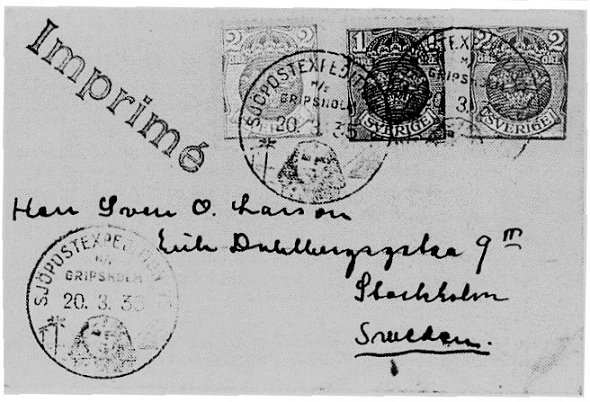
Other lines include the Navigation a Vapeur "Panhellenique" and the Société Misr de Navigation Maritime (Fig. 15), which used dated handstamps SP.S-1 and SP.S-2. A pictorial postmark was also used on the M/F Gripsholm in 1935.
Shore Facilities
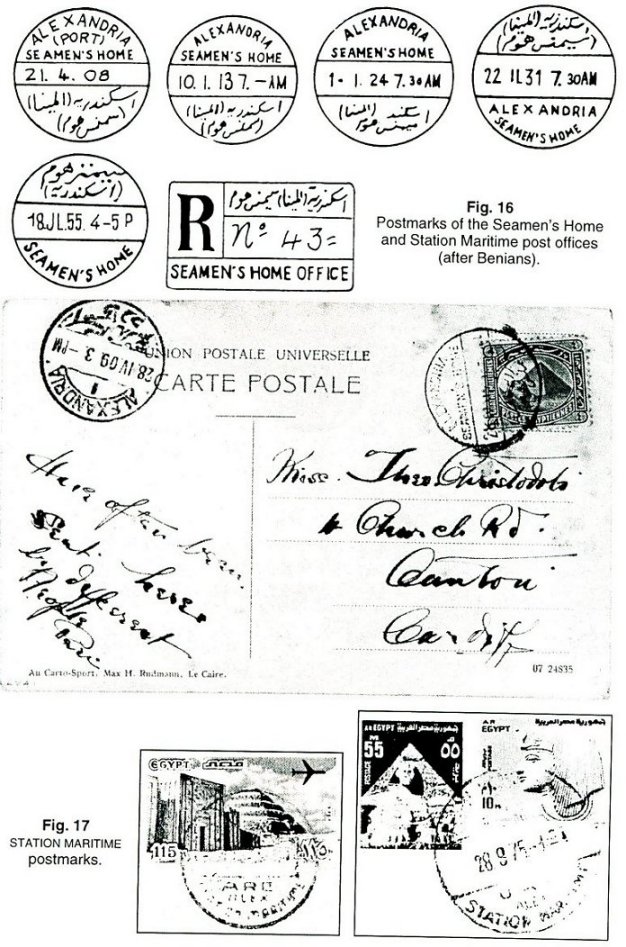
Postal facilities were provided at the docks in Alexandria, located inside the customs area. The Seamen's Home provided recreational and worship facilities. Five different date-stamps (Fig. 16) have been recorded between 1908 and 1955. Later, a post office named Station Maritime was opened (1975-80), possibly indicating a change of function to cater to passengers.
References
| 1. | C. Fox, QC VI (11), 133-6 (whole no. 71, Jan. 1973). |
| 2. | P.A.S. Smith, QC X11 (11/12), 233-5 (whole no. 139/140, Sep./Dec. 1986). |
| 3. | G. Boulad, L'OP No. 87, 445-51 (July 1954). |
| 4. | C.W. Minett, QC VI (6/7), 72-7 (whole no. 66/67, May 1966); J. Boulad d'Humieres, L'OP No. 123 (Apr./Oct.1970), pp. 366-81. |
| 5. | E. Drechsel, Paguebot Marks of Africa, Mediterranean Countries and their Islands, Robson Lowe Ltd., 1980; A.J. Revell, THAMEP I (8), 202-3 (Sep. 1957). |
| 6. | R. Hosking, Paquebot Cancellations of the World, self-published, Oxted, Surrey, 1977; Second Edition 1987. |
| 7. | L.. Alund, QC X1 (4), 137-8 (whole no. 121, March 1982). |
| 8. | E. Ey, Die Briefinarken der deutschen Postanstalten im Auslande and der deutschen Schutzgebiete, self-published, Augsburg, 1960, pp. 154, 171; A. Friedemann, Die Postwertzeicben and Entwertungen der Deutschen Postanstalten in der Sehutzgebieten and im Ausland, revised by 11. Wittmann, Vol. 3. Dr. Wittmann Verlag, Munich, 1969. |
| 9. | E. Drechsel, 1886-1986. A Century of German Ship Posts, Christie's Robson Lowe Ltd., 1987; P. Cockrill and A. Gottspenn, German Seapost Cancellations 1886-1939, Part 2, Philip Cockrill, London, 1987; E. Drechsel, Norddeutscher Lloyd, Bremen 1857-1970. History - Fleet - Ships - Mails, Vol. 1, Cordillera Publishing Co., Vancouver, Canada, 1994. |
| 10. | L. Alund, QC XI (6), 164-6 (whole no. 122, June 1982). |
| 11. | C.W. Minett, QC V1 (12), 145 (whole no. 72, Apr. 1969). |
| 12. | G. Boulad, L'OP No. 87, 445--51 (July 1954). |
| 13. | F.P. Traamberg and P. Cockrill, Netherlands Colonies, Maritime Markings and Ship Cancellations 1793-1939, Philip Cockrill, London, 1980. |
| 14. | R. Kreschel, QC XV (10), 275 (whole no. 173, June 1995). |
| 15. | P. Cockrill, Ocean Mails, self-published, London, 1939. p. 26. |
| 16. | W.T.F. Castle, Cyprus: Postal History and Postage Stamps, 2nd ed. Robson Lowe Ltd., London, 1971. pp. 196-7, 206; 3rd ed., 1987. pp. 156, 161, 167, 262. |
| 17. | J. Cooper, India Used Abroad, self-published, Bombay, 1950. pp. 97-100. |
| 18. | E.F. Hurt, and L.N. and M. Williams, Handbook of the Private Local Posts, F. Billig, New York, 1950. pp. 110-12. |
| 19. | Hurt and Williams, loc. cit. p. 18. |
| 20. | J. Sears, QC XV (3), 66-7 (whole no. 166, Sep. 1993) and XIV(8 ), 218-21 (whole no. 160, Dec. 1991). |
| 21. | F.W. Benians, QC X1 (5), 119-28 (whole no. 121, Mar. 1982). |
